updated 2026-11-26·11 min read
Amthauer IST-70
Unpad 1973 standardization (N=4,200), 9-subtest taxonomy, GE 0/1/2 rubric, 1:1 FA planar dissections, SO(3) 24-rotation cube math, Standardwert IQ scoring, and SEM profile reporting.
If you smooth an IQ norm curve artificially, you move the 120 IQ scholarship cutoff. Testing bureaus like LPTUI Universitas Indonesia, UPAP Universitas Gadjah Mada, and PIP Unpad don’t use smooth synthetic curves for Beasiswa Garuda, BIM, LPDP, or BUMN screening: they score against the 1973 Indonesian adaptation of Rudolf Amthauer’s Intelligenz-Struktur-Test (IST-70) by Tim Psikodiagnostika Fakultas Psikologi Universitas Padjadjaran (S. Djatnika and M. Subhan).
Flynn reconstructs all 9 timed subtests (ist-battery-unpad-1973, 176 items, 192 max raw points) and anchors every conversion straight to those Unpad 1973 senior high and university-candidate moments (, validated against LPTUI UI norms, ). I left the curve unsmoothed so the upper tail stays honest.
- 1953 / 1970Amthauer I-S-T and IST-70
Rudolf Amthauer establishes the 9-subtest Intelligenz-Struktur-Test and revises it in 1970 (Hogrefe, Göttingen).
- 1973Unpad Indonesian Standardization
S. Djatnika, M. Subhan, and Tim Psikodiagnostika Unpad adapt and standardize IST-70 for Indonesian populations.
- 2009 / 2010LPTUI UI Senior High & University Norms
LPSP3 / LPTUI Universitas Indonesia publishes normative tables across N = 4,200 senior high and university candidates.
- 2018UPAP UGM Scholarship Conversion Equations
UPAP UGM standardizes Standardwert and Deviation IQ conversion equations for scholarship and postgraduate selection.
9-Subtest Structure & Pacing
Pure testing time is 69 minutes, plus a 3-minute memorization sheet before Subtest ME (72 minutes total). Unused time from one section never carries over to the next.
| Code | German Name | Indonesian Name | Items | Time | Pace | Max | Cognitive Modality |
|---|---|---|---|---|---|---|---|
| SE | Satzergänzung | Melengkapi Kalimat | 20 | 6 min | 18s | 20 | Sentence logic & syntax |
| WA | Wortauswahl | Klasifikasi Kata | 20 | 6 min | 18s | 20 | Semantic odd-one-out |
| AN | Analogien | Analogi Kata | 20 | 7 min | 21s | 20 | Proportional analogies () |
| GE | Gemeinsamkeiten | Persamaan Kata | 16 | 8 min | 30s | 32 | Abstract verbal categories |
| RA | Rechenaufgaben | Hitungan Praktis | 20 | 10 min | 30s | 20 | Applied arithmetic |
| ZR | Zahlenreihen | Deret Angka | 20 | 10 min | 30s | 20 | Numerical recurrences |
| FA | Figurenauswahl | Pilihan Bentuk | 20 | 7 min | 21s | 20 | 2D shape assembly |
| WU | Würfelaufgaben | Rotasi Kubus | 20 | 9 min | 27s | 20 | Cube mental rotation |
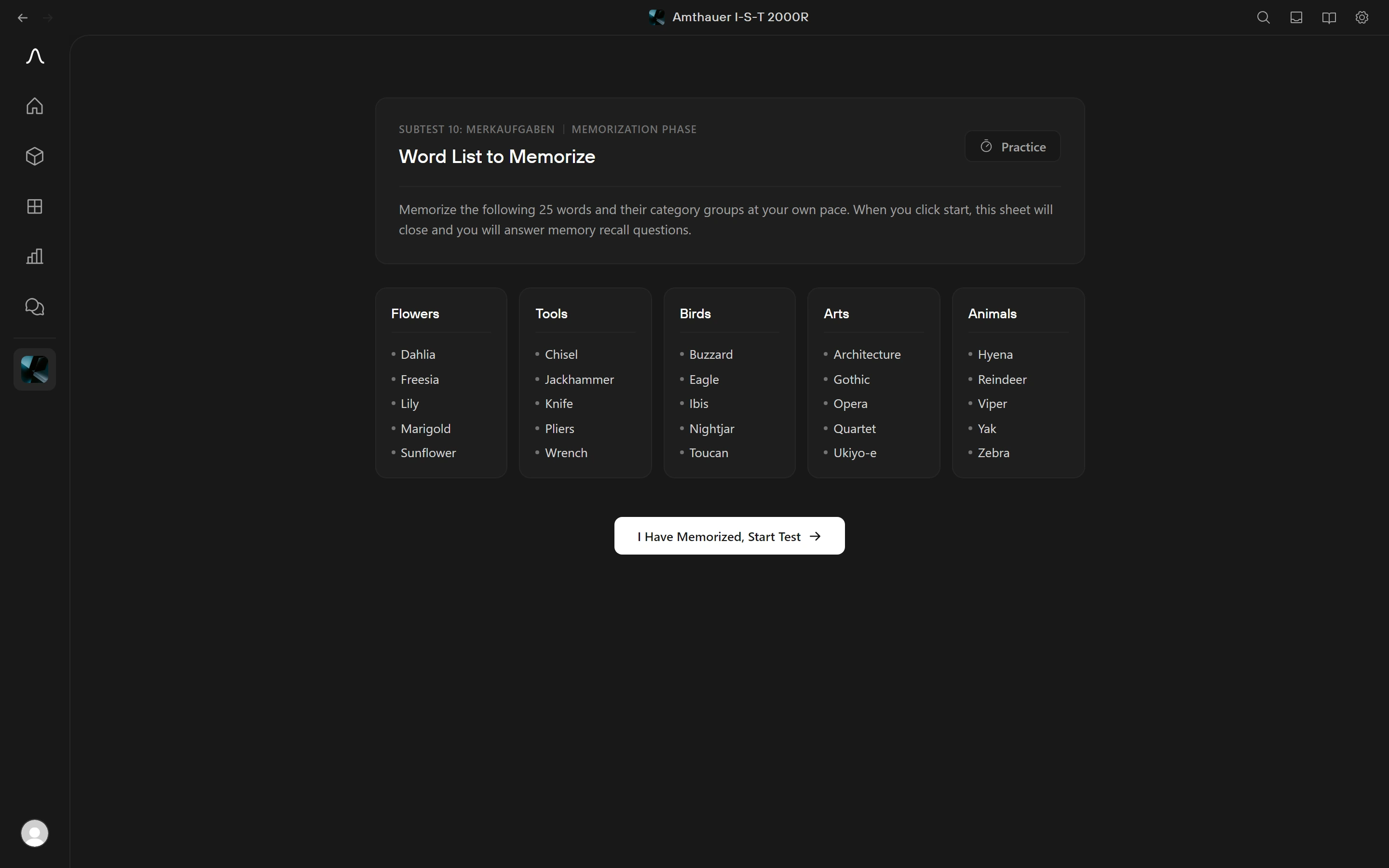
| ME | Merkaufgaben | Daya Ingat Kata | 20 | 6 min | 18s | 20 | Delayed word recall (3m study) |
Subtest GE: 0, 1, or 2-Point Concept Grading
Subtest GE (Gemeinsamkeiten) is the only open-ended section, worth up to 2 points per word pair (such as mawar - melati or besi - tembaga):
- 2 points: The formal superordinate category noun (bunga [flower], logam [metal]).
- 1 point: A shared physical or functional property (tanaman wangi [fragrant plant], benda keras [hard object]).
- 0 points: Concrete or situational associations (ditanam di halaman [planted in the yard]).
I first tried grading GE with LLM prompts and embedding cosine similarity, and both fell apart fast. Embeddings rewarded loose thematic overlap (scoring air [water] way too high for danau - selokan [lake - brook], where the Unpad rubric expects perairan), test-retest consistency fell below , and API calls added 400-1200ms of lag. Flynn uses deterministic regex lemma dictionaries built from the Unpad 1973 manual instead, so grading runs locally in under 0.1ms with .
Subtest FA: 1:1 Metric Rendering & Planar Dissections
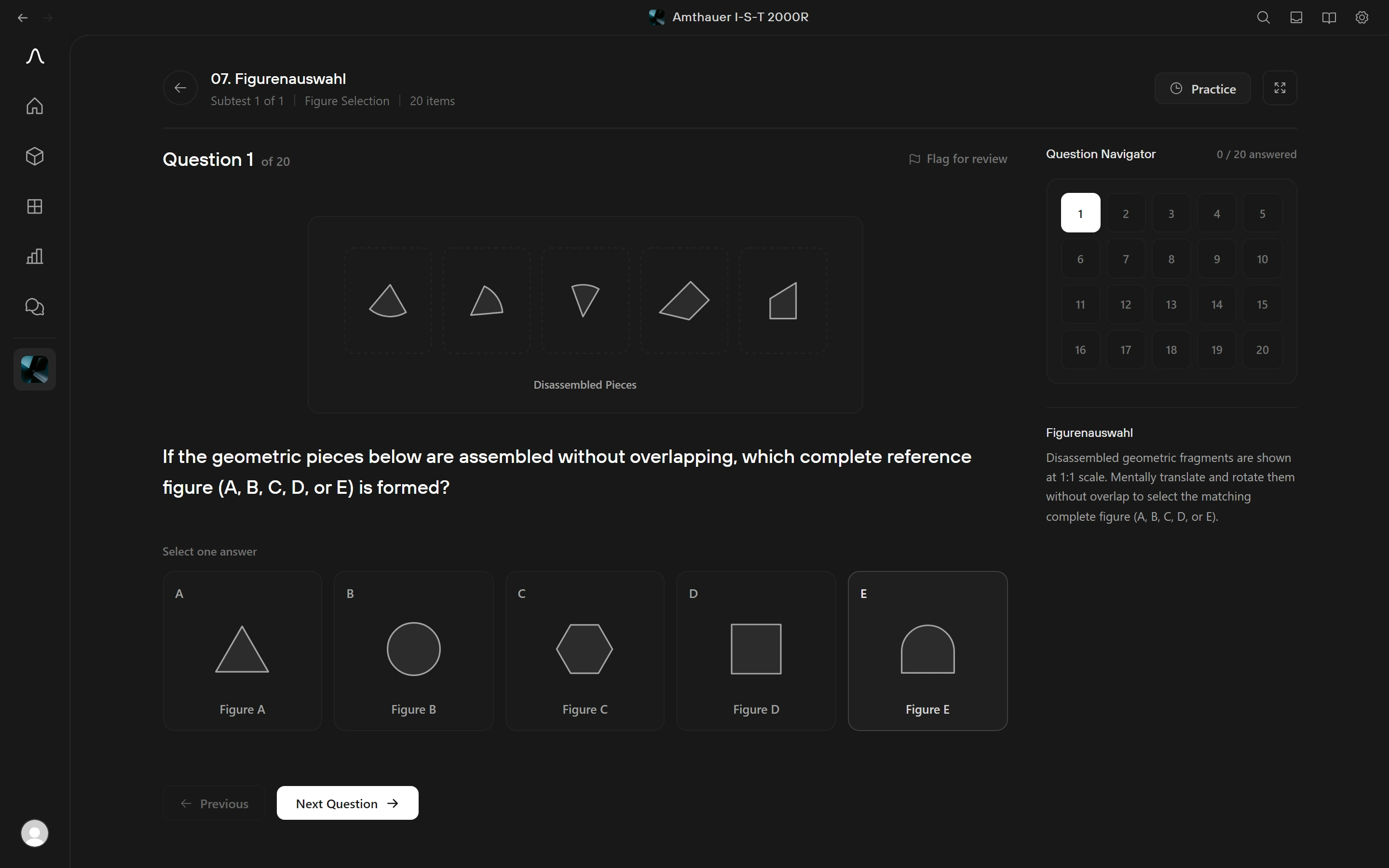
In Subtest FA (Figurenauswahl), you rotate disassembled polygon and curved fragments mentally until they form one of five complete reference silhouettes (A-E). Early renderers auto-fitted each option card and stage slot to its own bounding box. Wide shapes shrank (1.02x) while narrow targets and small pieces zoomed up (1.35x to 1.37x), distorting rendered SVG area by up to 1.73x. In 9 of the 40 legacy items, a single fragment rendered wider in pixels than the entire target figure it belonged to. Playtesting also caught Question 1 splitting a hexagon straight down the middle into trivially distinct pieces.
Flynn locks both the 440x110 fragment stage and every 82x82 reference option card to a fixed 0.85 physical metric scale (1.00x linear and area parity). What you see in the piece tray matches the edge lengths and curvature of options A-E without zoom distortion.
Each partition is checked before shipping against four geometric rules:
- Shared-radius circular pairs: Straight polygons alone let test-takers spot any curved piece on sight and pick the only curved option. Both reference sets pair two shapes with identical arc radii (
ist-batteryshares across the Circle and Rounded Dome;ist-battery-unpad-1973shares across the 3/4 Disc and Quarter-Rounded Block), so curved cuts still require matching straight chords and edge lengths. - No needle slivers or concave hooks: Pure straight pieces are strictly convex with minimum edge length units and interior angles , escalating monotonically from 3 pieces (easy) to 4 and 5 pieces (hard).
- Exact planar tiling: Summed fragment area matches the target option within polygonal discretization tolerance, and a
0.8-unit interior point-in-polygon grid confirms every interior point belongs to exactly one fragment with zero overlap or gap. - Non-zero rotations: Every fragment enters the tray rotated away from its assembled orientation.
Bank Separation & Orthographic Controls
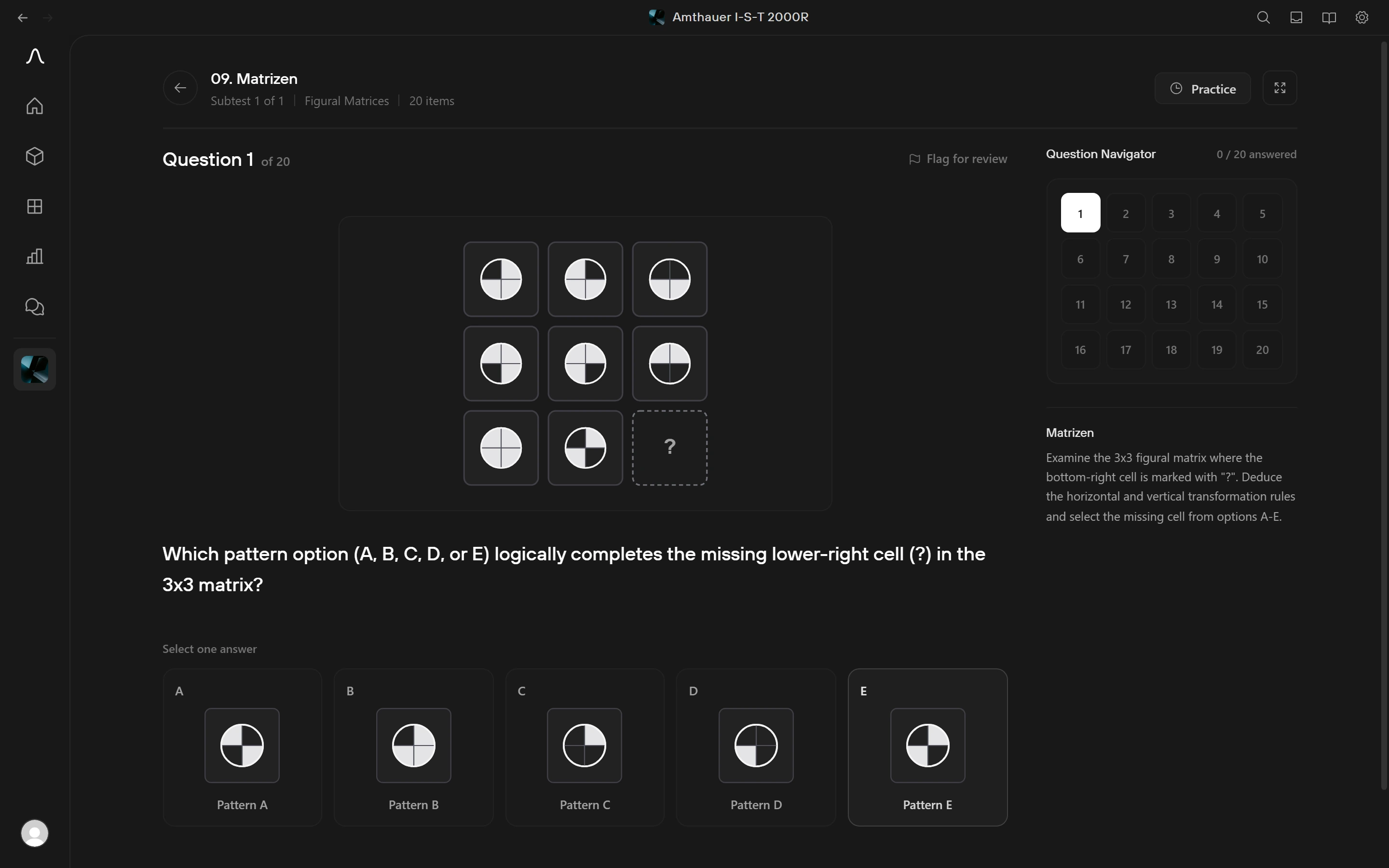
Both ist-battery (the 10-subtest, 200-item English I-S-T 2000R battery) and ist-battery-unpad-1973 (the 9-subtest, 176-item Indonesian IST-70 battery) hold completely independent, non-translated item banks across every verbal and quantitative subtest, plus separate FA reference sets and WU cube panels. Across every 20-item 5-option (A-E) subtest (including RA and ZR), correct keys follow an exact 4/4/4/4/4 distribution with maximum consecutive run length , and sentence completion (SE) options match the grammatical case of the blank so capitalization never leaks the key.
Subtest WU: Cube Rotation & Mirror Distractors
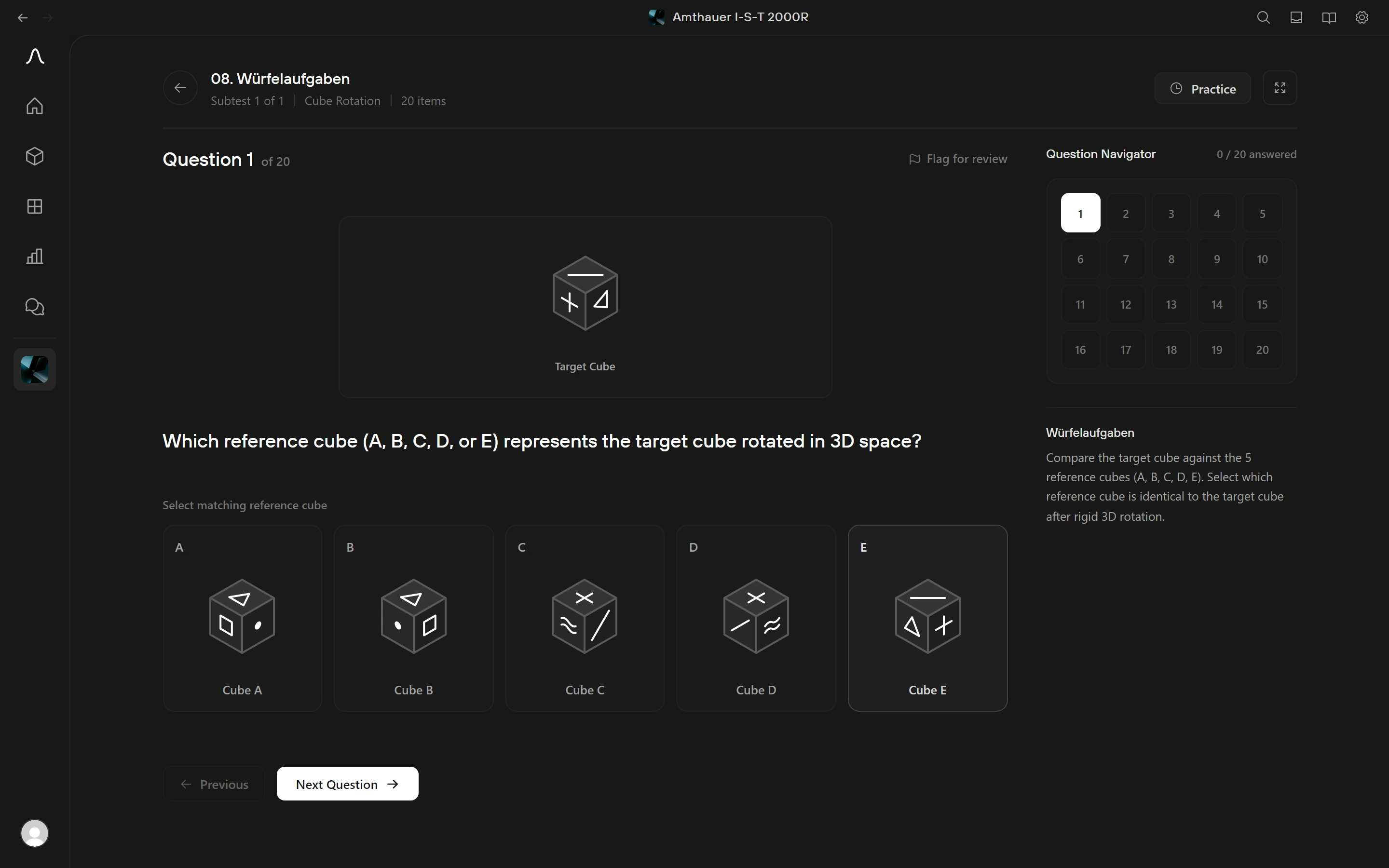
In Subtest WU, you compare a rotated target cube against 5 reference cubes (A-E). Early prototypes only stored the 3 visible faces (top, left, right), which broke Amthauer’s rule that unseen back faces can rotate into view (“mungkin terlihat tanda baru”).
Flynn tracks all 6 faces (Cube6Faces: top, bottom, left, right, rightBack, leftBack) and rotates them across all 24 valid 3D orientations of a cube. If you put random distractor symbols on the other cubes, test-takers quickly spot a 2D shortcut: just count shapes on screen and cross out any option with a symbol missing from the reference cube. To force real mental rotation (matching Shepard & Metzler’s linear rotation-angle latency), Flynn uses mirror-flipped cubes as distractors: they carry the exact same three shapes, just in impossible handedness, so 2D symbol counting won’t save you.
Math: SO(3) Octahedral Group & Chiral Handedness
Every physical cube rotation is an orthogonal matrix satisfying:
Those 24 elements partition into 5 conjugacy classes:
- Identity (no rotation): 1 element.
- and rotations around the 3 axes through opposite face centers: 6 elements.
- rotations around the 3 face-center axes: 3 elements.
- and rotations around the 4 body diagonals through opposite vertices: 8 elements.
- rotations around the 6 axes through opposite edge midpoints: 6 elements.
Let be the outward normal vectors of three visible faces meeting at a vertex in clockwise order. Any physical rotation preserves the scalar triple product:
A chiral enantiomer distractor reflects across a mirror plane (), flipping while keeping the exact same three face symbols.
Norm Conversions: Standardwert & Deviation IQ
Raw composite scores map linearly via the Unpad 1973 senior moments ((X - 84.0) / 16.5) into Standardwert (, , clamped to [70, 140]) and Wechsler Deviation IQ () following the UPAP UGM (2018) and LPTUI conversion equations. National scholarship cutoffs (Beasiswa Garuda, BIM, LPDP) require , which maps to (roughly top 9.12%, , or raw points).
Math & Code: Standardwert, Deviation IQ & SEM (computeDeviationIQ)
Under Classical Test Theory with and representative single-subtest reliability :
export function computeDeviationIQ(rawScore: number): {
  standardwert: number
  iq: number
} {
  const z = (rawScore - 84.0) / 16.5
  const sw = Math.min(140, Math.max(70, Math.round(100 + 10 * z)))
  const iq = Math.round(100 + 1.5 * (sw - 100))
  return { standardwert: sw, iq }
}
Psychometric Report Sheet, Average Band & SEM Whiskers
Completed sessions generate a printable A4 Psychometric Assessment Report that plots all nine subtests (SE through WU) across a 60-140 Standardwert vertical scale:
- Shaded Average Band (
90-109): The diagram shades the normative Amthauer average zone (, roughly around ) behind the profile polyline, paired with the six Amthauer IQ classification brackets (< 80Low,80-89Low Average,90-109Average,110-119High Average,120-130Superior, and> 130Very Superior). - () Whiskers: A 20-item subtest carries roughly of measurement noise (), so bare point dots trick students into over-reading tiny 2-3 point differences. Plotting vertical error whiskers keeps that confidence interval visible.
- 5-Tier Cognitive Matrix & Pacing Ratio: Each cognitive domain is rated on a
1-5scale (Low,Below,Avg,Good,High) alongside written domain interpretations. The session strip reportsTime Taken / Limitwith elapsed percentage against the 72-minute full-battery limit (69 minutes of active subtest timers plus the 3-minuteMEstudy window, or the exact subtest limit on single-subtest drills). Practice sessions allow elapsed time to exceed of the nominal limit so untimed review pacing remains transparent.
Practicing one subtest by itself returns deviationIq = null, for a single 20-item subtest only measures one narrow facet rather than full cognitive structure. Composite IQ only calculates when you finish all 9 subtests, and sessions with zero answers or under 25% engagement are flagged as abandoned.
Primary Sources: Amthauer IST-70 & Indonesian Norms
- Amthauer, R. (1953, 1970): I-S-T: Intelligenz-Struktur-Test & Handanweisung IST-70. Göttingen: Hogrefe.
- Djatnika, S., & Subhan, M. (1973): Standarisasi Tes Inteligensi Struktur (IST) Amthauer untuk Populasi Indonesia. Bandung: Fakultas Psikologi Unpad.
- Tim Psikodiagnostika Unpad (1973): Pedoman Pemeriksaan Psikologis: Manual IST. Bandung: Unpad Press.
- LPSP3 / LPTUI UI (2009, 2010): Norma Baku IST Pelajar SMA dan Mahasiswa Indonesia (). Jakarta: LPSP3 UI.
- UPAP UGM (2018): Standarisasi Standardwert dan Konversi Skor Inteligensi pada Seleksi Beasiswa dan Pascasarjana. Yogyakarta: UGM.
- Shepard, R. N., & Metzler, J. (1971): Mental rotation of three-dimensional objects. Science, 171(3972), 701-703.