updated 2026-11-26·4 min read
Getting Started
What Flynn is, why it exists, how practice and proctored modes work, and how the documentation is organized.
Flynn started one afternoon in my high school auditorium. While listening to someone explain Beasiswa Garuda or TKA, I learned about a strict 120 IQ cutoff right beside a table of kids sitting at 150-160. IQ itself is still debated, so filtering out students on one arbitrary line when they already clear the grades and SAT bar didn’t sit right. Naming a practice site meant for “raising” test scores after the Flynn effect (the long-run drift in population IQ norms) was far too funny to pass up, ergo Flynn. No paywalls, locked diagnostics, or paid tiers: everything stays open for students.
Why I Built This
If someone walks into a testing center cold and pulls a 118, they get filtered out before anyone reads their essays or grades, while people who drilled the question patterns walk out above 130. Standardized psychometrics aren’t magic verdicts on human worth; they are timed puzzles with repeatable templates, i.e., mechanics you can actually train.
I put Flynn together so anyone can practice those formats under honest math:
- To see how scholarship cutoffs actually work
Clear benchmarks like the 120 Deviation IQ cutoff (SW >= 113.33) without guessing how raw scores map to Standardwert and IQ.
- To train under UTBK-SNBT scoring
Simulate the 7-subtest national timing and 41-node Bayesian EAP scoring on the 200-1000 scale instead of rough percentage grades.
- To drill spatial and pattern subtests directly
Practice Cube Rotation (WU), Figure Selection (FA), Figural Matrices (MA), and number series alongside local session stats, streaks, ELO, and daily seeds.
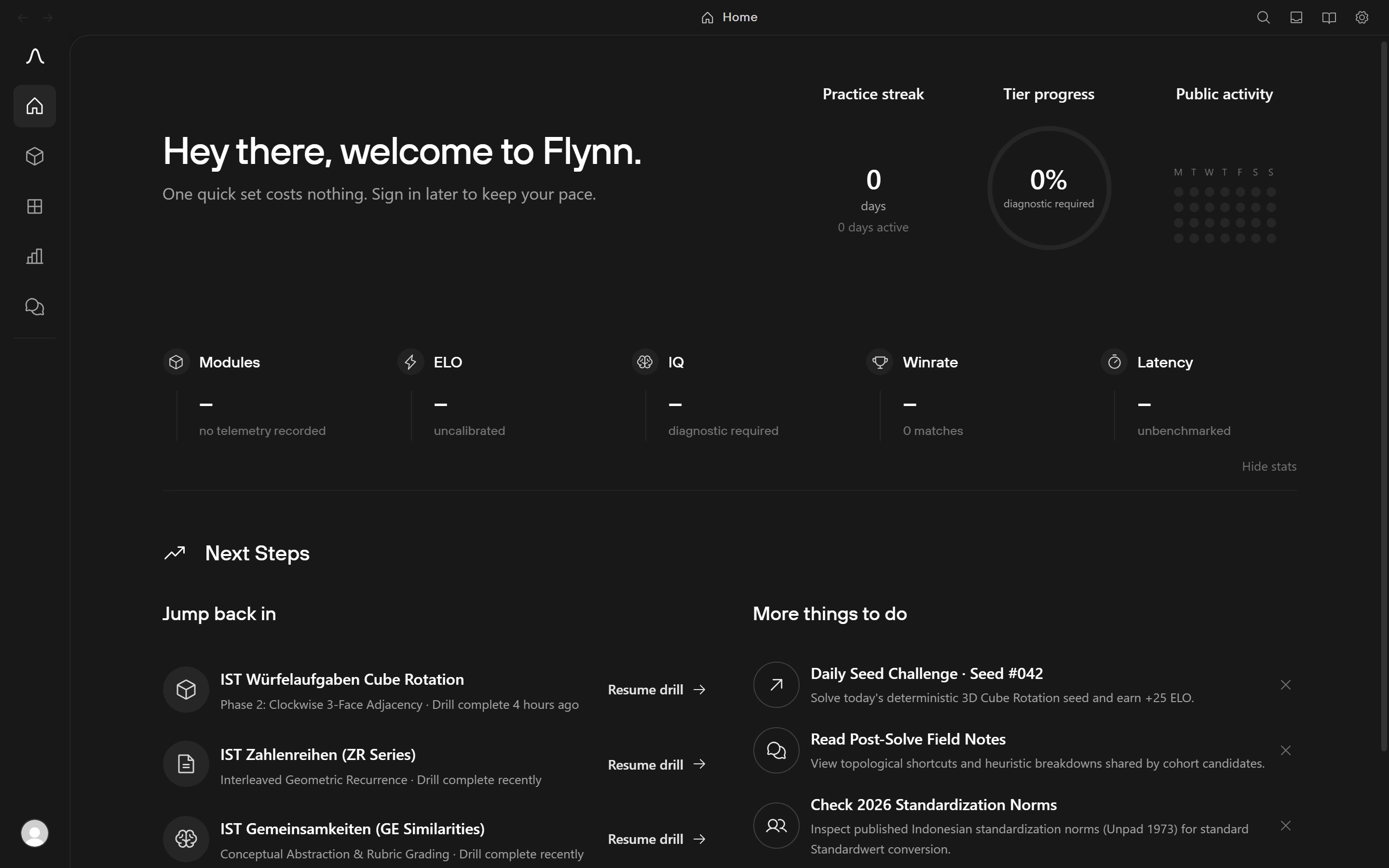
Navigating the App
- Quick search: Press
Cmd+K(orCtrl+K) inside Flynn’s/docsviewer to focus documentation search, or anywhere here inlietzscheto search the wiki. - Psychometric Reports & PDF Export: Completed IST sessions generate a printable A4 report (via
ISTPdfViewer) with a60-140Standardwert profile chart, a shaded90-109average band, and () error whiskers so you don’t over-read a 2-point gap between subtests. - Freeform Scratchpad: The
/canvasworkspace gives you an infinite pan-and-zoom grid where you can spawn, drag, and resize frames as scratch space (the undo, redo, text, and marker buttons on the bottom bar are still UI stubs right now). - WIP Tabs: The
Materials,Ranked, andDiscussionstabs on module pages (and the sidebarRanked/Discussionsviews) currently render WIPHammerplaceholders (at least for now), while the active exam runners and reports are live.
Practice Mode (/practice)
Untimed drilling with flexible navigation and section previews so you can figure out how questions work. Elapsed time is still tracked against the nominal exam limit (Time Taken / Limit, which can exceed 100% when you take extra time) and stamped PRACTICE on the report sheet.
Take Mode (/take)
Fullscreen timed exam mode with hidden navigation, strict non-transferable section cutoffs, server-side grading, and a PROCTORED report stamp. Guest progress stays in your browser’s local storage, or you can sign in with Google or GitHub to keep history across devices.
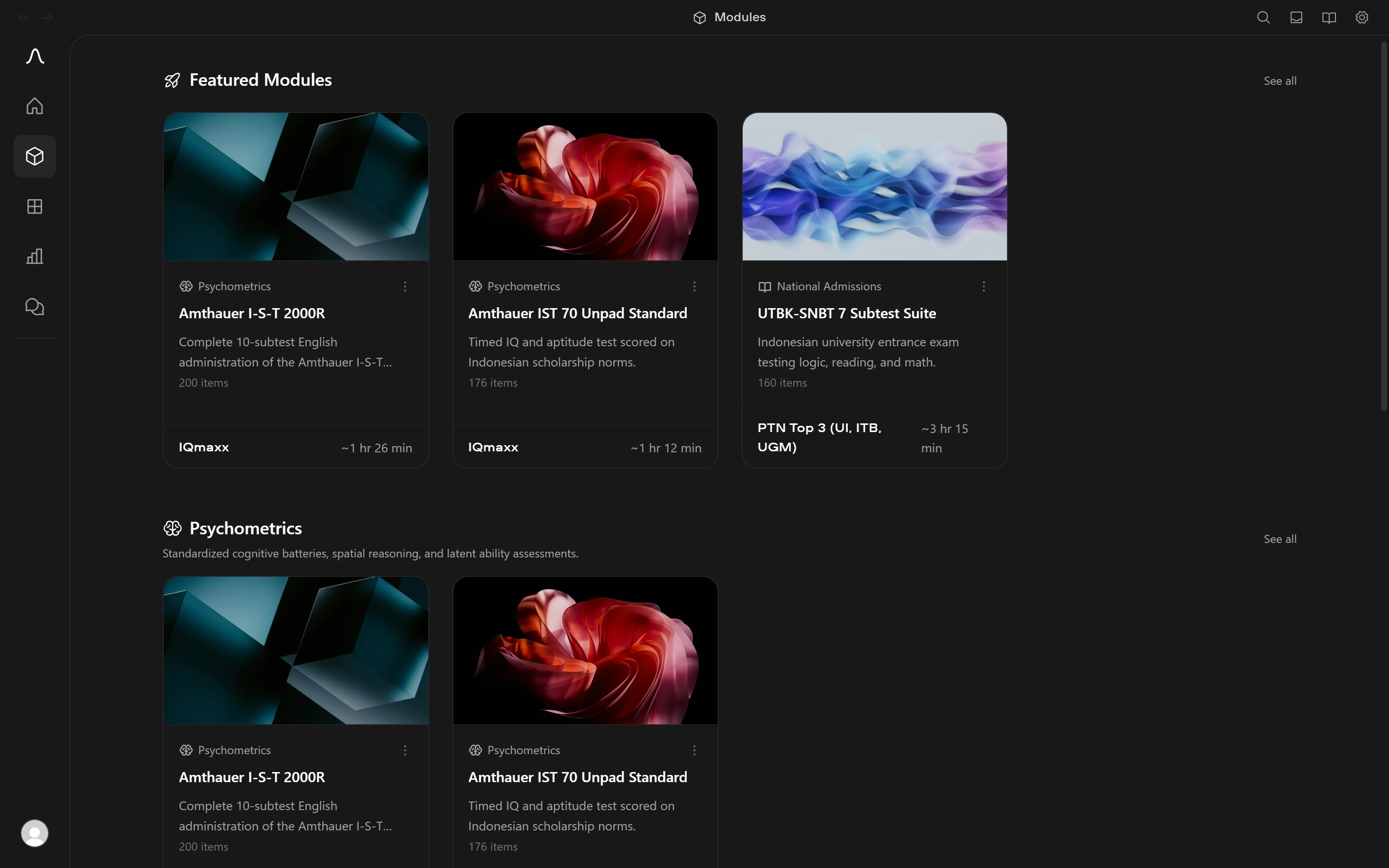
Documentation Map
Zero-latency local simulation, Better Auth JWKS verification, background-safe timers, and SplitMix32 deterministic seeds.
Attempt 1 canonical items vs Attempt 2+ procedural AIG (WU, PK, PM), plus the three active batteries and an archived CFIT spec.
Turso libSQL schema, auth/session split, sealed-key grading, and random-seed generator fixes.
Non-affiliation stance, 17 U.S.C. § 102(b) fair use, Terms of Service, and edge telemetry privacy.
For the math and psychometric rules behind the exams, continue to Psychometrics & Research. For system engineering details, see Platform Architecture and Database & Empirical Evaluation. For terms and telemetry disclosures, see Legal & Governance.