updated 2026-11-26·8 min read
UTBK-SNBT Item Response Theory
Permendikbudristek No. 48/2022 7-subtest blueprint, Birnbaum 3PL model, 41-node Bayesian EAP quadrature, Test Information, SEM, and BPPP 200-1000 scaling.
My first UTBK scorer solved for ability using Newton-Raphson Maximum Likelihood Estimation, which worked fine on middle-of-the-pack scores and blew up with NaN the moment someone hit 0/160 or 160/160 (driving toward and dividing by zero). Then while auditing the item bank, one quantitative item (utbk-pm-02, ) turned out to mix thousands of rupiah in the prompt with raw rupiah in the answer key.
Scoring the Ujian Tulis Berbasis Komputer Seleksi Nasional Berdasarkan Tes (UTBK-SNBT) honestly means grading the full 160-item, 195-minute Permendikbudristek No. 48/2022 structure with Birnbaum’s 3-Parameter Logistic (3PL) model instead of flat percentage correct, and solving ability with a 41-node Bayesian Expected A Posteriori (EAP) estimator that doesn’t crash on extreme score vectors.
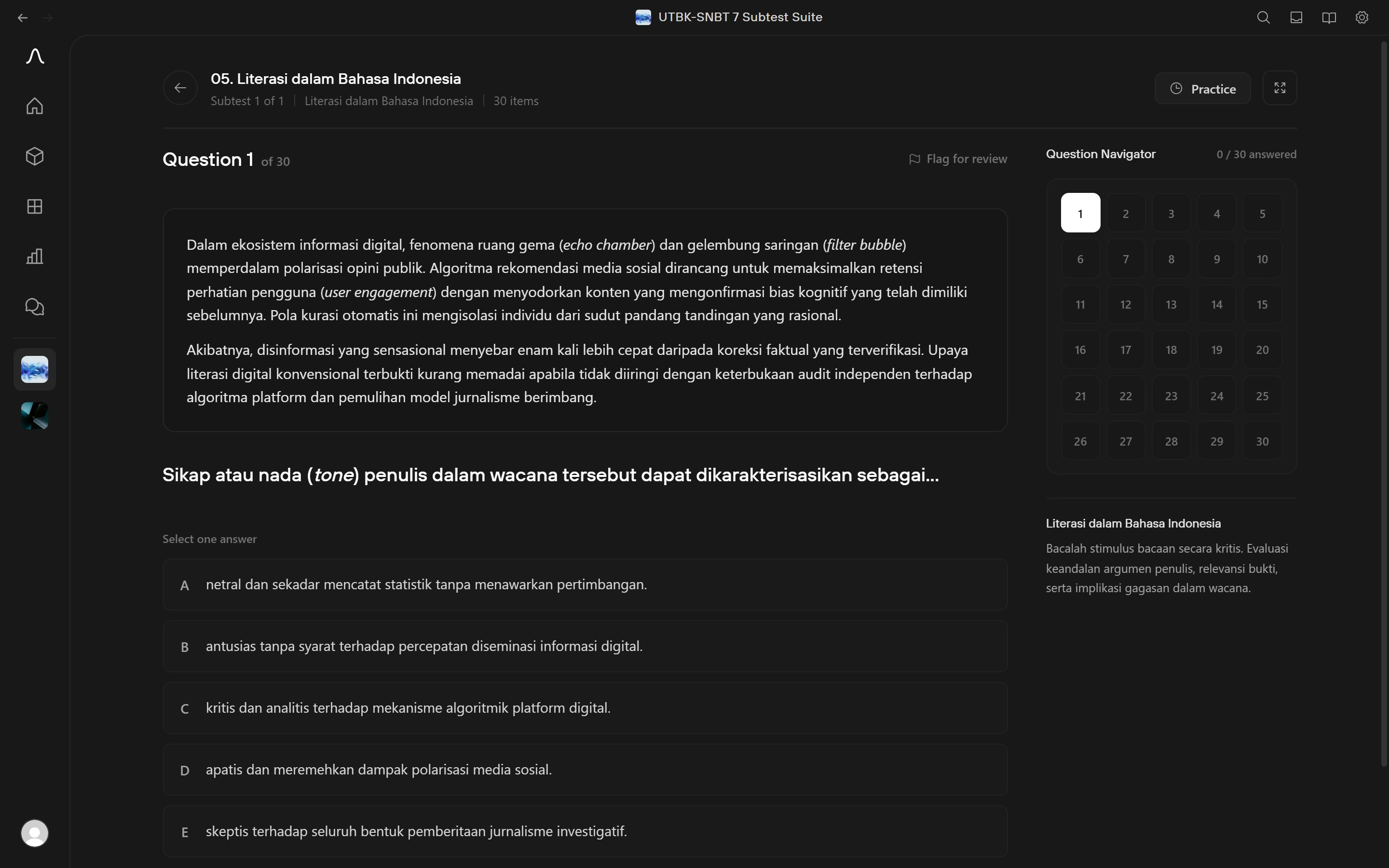
7-Subtest National Blueprint (160 Items, 195 Minutes)
There are 152 multiple-choice items and 8 short numeric fill-in items split across TPS (Tes Potensi Skolastik) and Literasi:
National Blueprint Table: TPS & Literasi (7 Subtests, 160 Items)
| Cluster | Code | Subtest | Items | Time | Pace | Format |
|---|---|---|---|---|---|---|
| TPS | PU | Penalaran Umum | 30 | 30 min | 60s / item | 5-Option MCQ |
| TPS | PBM | Pemahaman Bacaan & Menulis | 20 | 25 min | 75s / item | 5-Option MCQ |
| TPS | PPU | Pengetahuan & Pemahaman Umum | 20 | 15 min | 45s / item | 5-Option MCQ |
| TPS | PK | Pengetahuan Kuantitatif | 20 | 20 min | 60s / item | MCQ + Numeric Fill-in |
| Literasi | LBI | Literasi dalam Bahasa Indonesia | 30 | 42.5 min | 85s / item | Reading Passage MCQ |
| Literasi | LBE | Literasi dalam Bahasa Inggris | 20 | 20 min | 60s / item | Reading Passage MCQ |
| Literasi | PM | Penalaran Matematika | 20 | 42.5 min | 127.5s / item | MCQ + Numeric Fill-in |
Birnbaum 3PL & 41-Node Bayesian EAP
Under the 3PL model (Birnbaum, 1968; Lord, 1980), each item carries three parameters:
- : Item discrimination (how steeply an item separates higher and lower ability around ).
- : Item difficulty in logits.
- : Lower pseudo-guessing asymptote, set to
0.20for 5-choice MCQs and0.0for PK/PM numeric fill-ins (where 1-of-5 guessing doesn’t apply).
Instead of Newton-Raphson MLE, Flynn evaluates a 41-node uniform-grid Bayesian EAP quadrature over with step size and standard normal prior weights. Subtracting the peak log-likelihood before exponentiating keeps 160-item products from underflowing IEEE 754 floats, and the Gaussian prior pulls empty and perfect scores smoothly to finite bounds alongside a 95% confidence interval from the posterior SEM.
Math: Birnbaum 3PL, EAP Quadrature, Test Information & SEM
Birnbaum 3PL Probability ( aligns the logistic curve to the normal ogive within ):
Log-Domain Bayesian EAP Estimator ():
Item / Test Information & Posterior SEM ( CI ):
Implementation: computeEapTheta (src/utils/irtScoring.ts)
export function p3PL(theta: number, a = 1.2, b = 0.0, c = 0.20): number {
  const exponent = -1.702 * a * (theta - b)
  if (exponent > 50) return c
  if (exponent < -50) return 1.0
  return c + (1.0 - c) / (1.0 + Math.exp(exponent))
}

export function computeEapTheta(
  responses: { isCorrect: boolean; a: number; b: number; c: number }[]
): { theta: number; sem: number } {
  const NODES = 41
  const MIN_THETA = -4.0
  const STEP = 8.0 / (NODES - 1)

  const logLikelihoods = new Float64Array(NODES)
  let maxLogLikelihood = -Infinity

  for (let k = 0; k < NODES; k++) {
    const thetaK = MIN_THETA + k * STEP
    let logL = 0
    for (const item of responses) {
      const p = p3PL(thetaK, item.a, item.b, item.c)
      const clampedP = Math.max(1e-12, Math.min(1.0 - 1e-12, p))
      logL += item.isCorrect ? Math.log(clampedP) : Math.log(1.0 - clampedP)
    }
    logLikelihoods[k] = logL
    if (logL > maxLogLikelihood) maxLogLikelihood = logL
  }

  let numerator = 0
  let denominator = 0
  const weights = new Float64Array(NODES)

  for (let k = 0; k < NODES; k++) {
    const thetaK = MIN_THETA + k * STEP
    const prior = Math.exp(-0.5 * thetaK * thetaK) / Math.sqrt(2 * Math.PI)
    const w = Math.exp(logLikelihoods[k] - maxLogLikelihood) * prior * STEP
    weights[k] = w
    numerator += thetaK * w
    denominator += w
  }

  const theta = Math.max(-4.0, Math.min(4.0, denominator > 0 ? numerator / denominator : 0))

  let variance = 0
  for (let k = 0; k < NODES; k++) {
    const diff = MIN_THETA + k * STEP - theta
    variance += diff * diff * weights[k]
  }
  const sem = Math.sqrt(Math.max(1e-4, denominator > 0 ? variance / denominator : 1.0))

  return { theta, sem }
}
BPPP 200-1000 Scale & Procedural AIG
Latent ability maps linearly onto the BPPP scale () via min(1000, max(200, round(500 + 100 * theta))).
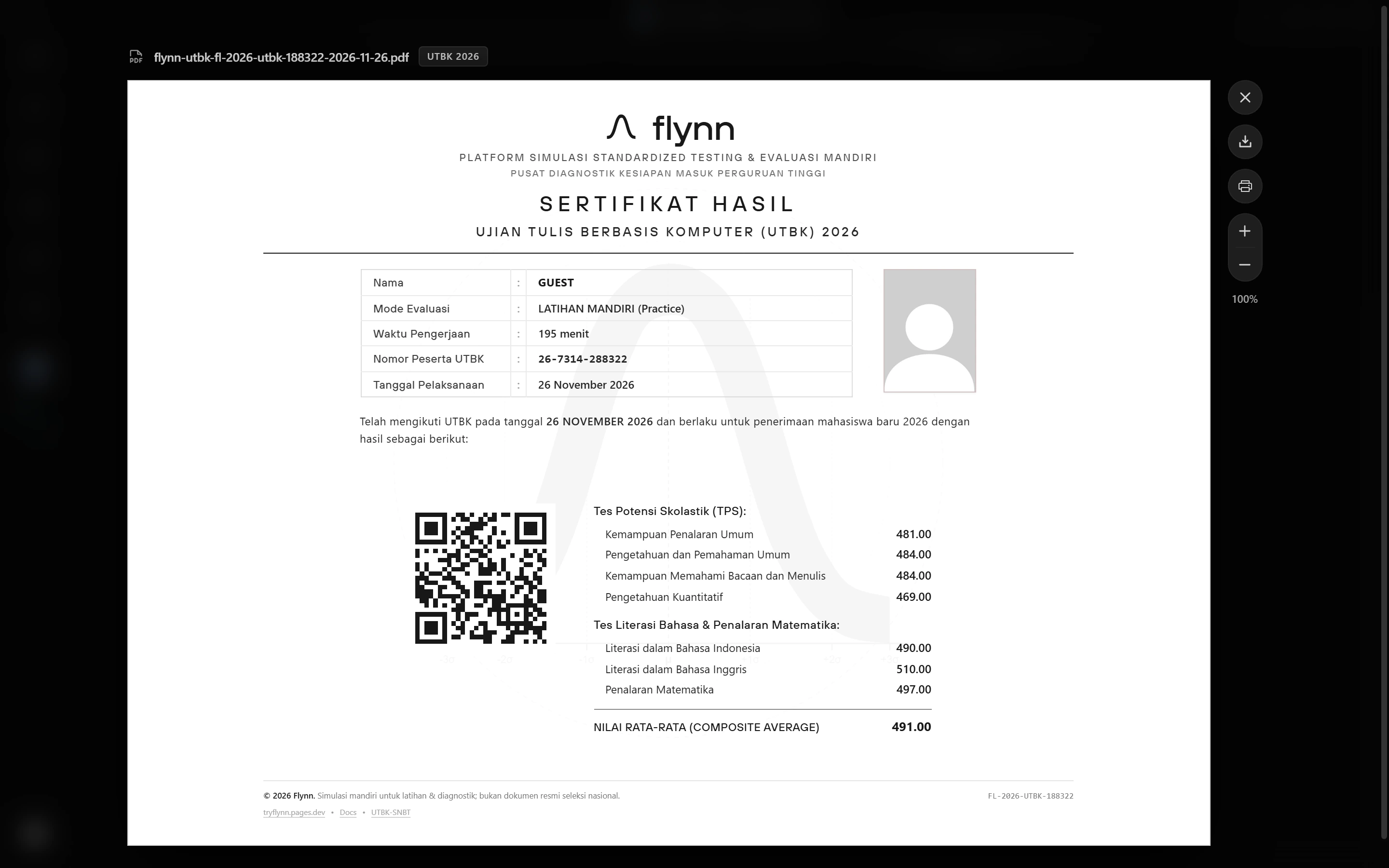
For the printable landscape certificate (UTBKCertificateDocument.tsx), I built a zero-dependency procedural SVG QR code (UTBKProceduralQrCode.tsx) and Gaussian bell-curve watermark (UTBKWatermarkSvg.tsx) directly instead of pulling in 50+ KB qrcode or html2canvas bundles, and toSafeDataUrl pre-inlines external OAuth avatars as base64 data URLs so CORS doesn’t taint canvas PDF exports.
For Attempt 2+ drills (PK and PM), Flynn applies cognitive Automated Item Generation (Embretson, 1999; Gierl & Haladyna, 2012): structural radicals that lock item difficulty stay fixed while surface incidentals mutate deterministically via SplitMix32. See Platform Architecture for 4-hour JWT session handling and Database & Empirical Evaluation for the log-domain stabilization details and algebraic generator fixes.
Every canonical bank also runs through automated checks before shipping to catch unit mismatches (like utbk-pm-02 mixing thousands of rupiah with raw rupiah) and competing synonym distractors (berkala vs serentak for sering). Option order stays locked on Data Sufficiency and -vs- comparisons, MCQ keys balance within each subtest (max streak ), and longest-option keys stay under across reading passages so you can’t guess answers by word length.
Flynn is an independent study platform with no affiliation to BPPP, SNPMB, or Kemendikbudristek. Item parameters () are instrument-calibrated weights rather than official national cohort parameterizations, and scaled scores are for private practice only.
Primary Sources: UTBK-SNBT & 3PL IRT
- Permendikbudristek No. 48/2022 & BP-SNPMB Framework: Official 7-subtest structure, 160-item blueprint, and 200-1000 standard scale.
- Birnbaum, A. (1968): Some latent trait models and their use in inferring an examinee’s ability. In Lord & Novick, Statistical Theories of Mental Test Scores.
- Lord, F. M. (1980): Applications of Item Response Theory to Practical Testing Problems. Lawrence Erlbaum Associates.
- Embretson, S. E. (1999) & Gierl, M. J., & Haladyna, T. M. (2012): Cognitive model-based Automatic Item Generation (radical-incidental parameterization).